Showing posts with label Diaper. Show all posts

Friday, April 27, 2012

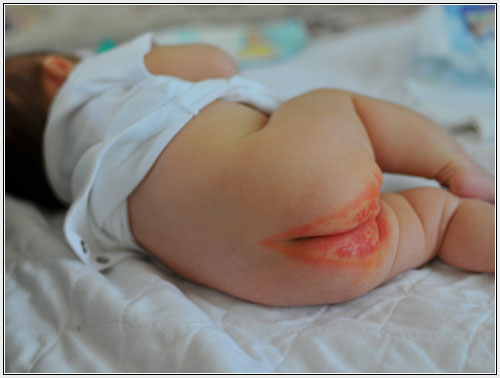
Diaper rash In Baby

3 comments

Diaper rash is a skin condition that develops in the area under a baby's diaper.

Causes

Diaper rash is common in infants between 4 and 15 months old and may be noticed more when babies start eating solid foods.
Diaper rash caused by infection with a yeast or fungus called Candida is very common in children. Candida is found everywhere in the environment and grows best in hot and humid, like under a diaper. A diaper rash is more related to fungi likely to occur in babies:
  • Not kept clean and dry
  • Are taking antibiotics, or whose mothers are taking antibiotics while breastfeeding
  • Have more frequent stools
Other causes of diaper rash include:
  • Acids in the stool (seen more often when the child has diarrhea)
  • Ammonia (produced when bacteria break down the urine)
  • Diapers that are too tight or rub the skin
  • Reactions to soaps and other products used to clean cloth diapers
  • Too much moisture

Symptoms

You may notice the following in the diaper area for your child:
  • Rash or outbreak of bright red becomes larger
  • Red scaly areas live in the scrotum and penis in boys
  • Or red scaly areas on the lips and vagina in girls
  • Pimples, blisters, ulcers, large bumps or pus-filled sores
  • Smaller red patches (called satellite lesions) that grow and are mixed with other patches
Older babies can scratch when they removed the diaper
Diaper rash usually does not spread beyond the edge of it.

Exams and Tests

Diaper rash or yeast related fungi often can be diagnosed only with its appearance. The examination of potassium hydroxide (KOH) can confirm a diagnosis of Candida

Treatment

The best treatment for diaper rash is to keep the diaper area clean and dry. This will also help prevent new dermatitis.
  • Always wash your hands after changing a diaper
  • Ask your doctor whether a cream for diaper rash would. Products based on zinc oxide or petrolatum help keep moisture away from the baby's skin when applied to the skin clean and dry
  • Avoid using wipes that contain alcohol or perfume as they can dry or irritate the skin
  • Do not use corn starch in your baby's bottom as it can worsen a diaper rash yeast
  • Do not use talc (talcum powder), since it can penetrate into the baby's lungs
  • Frequently change your baby's diaper, and as soon as possible after it urinates or defecates
  • Put your baby in a towel without a diaper when possible. The longer you can keep the diaper off, the better.
  • Pat the area dry or let air dry
  • Place loose diapers. Diapers that are too tight do not allow enough air and can rub and irritate the waist or thighs of the baby.
  • Use water and a soft cloth or cotton ball to gently clean the diaper area with each change it. Avoid rubbing or scrubbing the area. You can use a squirt bottle of water for sensitive areas
  • The use of highly absorbent diapers helps to keep skin dry and reduces the likelihood of infection
If you use cloth diapers:
  • Avoid plastic or rubber pants over the diaper. They do not allow enough air to pass
  • DO NOT use fabric softeners or dryer sheets as they can worsen the rash
  • When washing cloth diapers, rinse 2 or 3 times to remove all soap if your child has a rash or has had prior
MEDICATIONS:
Antifungal creams and ointments for topical skin clear up infections caused by yeast. Nystatin, miconazole, clotrimazole and ketoconazole are common.
Sometimes you can use a mild topical corticosteroid cream. Talk to your doctor before trying this with your baby.

Forecast

The rash usually responds well to treatment.

Complications

The complications associated diaper rash Candida may include:
  • Secondary infection

When to Contact a Medical Professional

Call your doctor if:
  • The rash gets worse or does not go away in 2 to 3 days.
  • The rash spreads to the abdomen, back, arms or face.
  • You notice pimples, blisters, ulcers, large bumps or pus-filled sores.
  • Your baby has a fever.
  • Your baby is taking an antibiotic and develops a bright red rash with spots on their edges. This could be a yeast infection.
  • Your baby develops a rash during the first 6 weeks of life.

Alternative Names

Diaper rash associated with Candida, Candida diaper rash, Diaper Rash

Saturday, March 31, 2012

Take off the diaper

0 comments

Approximately two years of age when the child begins to have some control over half its excretory function.


There are no specific ages since learning of each child is individual, although it is known that approximately two to three years the child should control the pee and poop little later. As proposed age limit two years, age at which we should consult with your doctor if there is any physical or emotional problem.

The withdrawal phase of the diaper is for children a new challenge that must confront unarmed, no security, so it is imperative that parents may bring the situation to not cause the child fears or resistance.
First you should make sure that it is the time when your child wants to stop using the diaper, never force the situation because you decide that now is the time. Each child is in its development phase and some find it harder than others, gives your child time to reach this maturity.
Al principio la retirada<br>del pañal será dificil
At first the withdrawal
the diaper is difficult
For your part you should be aware of certain signs that may give us clues as to whether the time has come. These tracks are often invisible to some and are important, such as whether the child wants to get on the toilet and sit as the elderly, also notes if you like flushing or want to get older underwear as his brother.
One important thing is to monitor the urinary response, checks for long periods in which the diaper is dry or after the night or nap time is kept dry, this indicates that the time is coming and that the child controls a little more his sphincter.
On the other hand look at what their response when the diaper is wet or dirty, look to see if it bothers you, pull it, I want to remove, this indicates that mature and already realizes he has urinated, smallest thing not being identified.
In her non-verbal communication can also find some notes if you move tracks anxious before wetting or stops and stands still just before doing so, this indicates that it is realizing that you are urinating and therefore may control if we give instructions.
When taught to use the toilet or urinal will be very helpful to use a model, for example may be the mother and brother
Is a gradual process
Like everything in the child, the final withdrawal of the diaper will need a gradual learning process with errors and successes for which we must be prepared.
Our attitude should be calm and understanding giving explanations to the child every time you get a goal or every time you make a mistake, our goal will not feel bad every time you pee and show up naturally happens to all and normal children. We will make every effort to avoid criticism, jokes for adults or other siblings since the child may feel guilty and lose self-esteem.
Although he wet his pants or the bed several times, never complain of dirty clothes or work giving because believe it is their fault and not evolve, you will feel pressured by the environment and this will be counterproductive.
When taught to use the toilet or urinal will be very helpful to use a model, for example may be the mother and one brother.
The child sees the other as they use it naturally and it will get used to it too.
We also help the dolls that pee or poop or the stories they talk about it, we can invent characters and draw them so that the child can color in situations always in the bathroom.
To get the child used the potty in the toilet first and then he will sit every day several times, but do nothing, in order to associate the object to the excretory function.
Tips
When I buy underwear or potty more you will engage in the purchase, for the point which you like best and often delude with the idea of ​​being more and get it. We must not hesitate for a moment that will get it, especially if he is ahead. Messages will always support and encouragement but not excessive for generarle not a fear of failure then we disappoint us. The key is normal.
Celebrate each success especially to provoke motivation, remember that rewarded behavior is repeated over time and tend to disappear or punished not improve, so that punishment is not a good weapon to get our son to control the sphincter. Note that is a growth stage and will like the other, remember when you have lots of sheets to wash and take it quiet
Avoid at all costs comparison with other children their age because it will make you feel inferior if others have done it and he did not. This process avoids contact with mothers who boast of the achievements of their children and to make you feel bad to you. Explain that each takes time and that's not good or bad, if you resort to some as it is for him to get information on how you achieved the other, so that he does well to see if it works, but never compare him or minus valorarle.
It uses older siblings or cousins ​​to encourage him by telling their experiences, explain to children that your child is sad because they can not control the pee and then you encourage others, be willing to help.
Finally, keep in mind that this is a time of change in the child that will provoke fears and insecurities, do not mix other situations that may cause anxiety because then it will overflow. If you are going towards changes in the family leaves the control of pee later. Address changes, new schools, vacation or unbalance the child separations and more pressure will be counterproductive, expected to pass.
 

Baby Smile Tips & Ariticle Copyright 2008 All Rights Reserved Baby Blog Designed by Ipiet | All Image Presented by Tadpole's Notez