Tuesday, May 15, 2012

How can I reduce my child's fever without medicine?

0 comments

Fever is actually a healing function. The immune system, metabolism and blood circulation are stimulated and the body is doing hard work to cope with the infection are. Fever can also help your child to be healthy again as soon as possible. But high fever is also stressful for your child and, if it continues to rise (see also the third to last paragraph), and dangerous. To avoid having to resort to antipyretic drugs such as acetaminophen or ibuprofen have - or if you do not have at hand - you can also try alternative methods to reduce the fever your child. You should always be aware that these alternative procedures for reduction of fever children are exhausting. In infants and young children under 3 years, you should therefore not possible to apply. Here are some possible applications:


  • Create a cool, damp washcloth on the forehead of your child, while it rests.

  • Bathing your baby in the bath at a water temperature one degree lower than its body temperature. Enter to gradually cool water until the temperature is ten degrees below its body temperature. After ten minutes, take the child out of the tub and measure the fever . If the fever be dropped, you can repeat the process after a while - but only if the child does not freeze! Rub your child's body parts that feel hot, with a wet sponge. When the water evaporates on the skin, and creates cool the fever is reduced. Do not use too cold water. It may mean that your child shivering in the cold and the temperature rises. Similarly, you should your child do not rub with rubbing alcohol (an old-fashioned remedy for fever). It can cause an increase of fever and possibly even alcohol poisoning.

  • Offer your child plenty of fluids and cooled food to, such as ice cream and yogurt, to help the body to cool off from the inside and to have enough liquid.

  • Use a fan. Here, too, do not freeze your child. Turn the fan on a low setting. The air should not be aimed directly at your child, but let the air circulate around your child.

  • Observe your child closely. If it is very hot, undressing his upper body and cover it with only a bed sheet. It begins to freeze, or getting chills it, pull it back a little and cover it with a warm blanket.

  • Stay at home in a cool place. Or if you're outside, find a place in the shade.
Call your doctor immediately if your child is younger than 3 months and has a fever over 38 degrees.
When a baby is 3-5 months old, call a doctor if the fever to well above 38.5 degrees Celsius, or more increases.
If it is 6 months or older age, you need the advice of a doctor if the fever to 39.5 degrees centigrade or more rises. No matter how old your child is, call a physician immediately if fever is not only but also other serious symptoms indicating such as difficulty breathing or red spots on his skin is or can not bend the chin to the chest. You could be a sign of a serious bacterial infection. To your child for symptoms of colds and flu - fever, apart from - to help you look at our list of 10 safe home remedies to soothe a sick child .

Tuesday, May 8, 2012

Baby And Flu

0 comments


How do I know if my child get the flu and not just a common cold is?

This is sometimes not easy. When young children are similar to flu symptoms to those of other diseases, such as a cold. In this sense, your child might have the flu, when it suddenly fever gets that increases over a longer period to more than 38 degrees. This is followed by symptoms like a runny nose and dry cough. When cold and cough distinctly noticeable before the fever, then it's more of a cold. Your child will probably be no appetite, have a sore throat and swollen tonsils. Influenza can also diarrhea and vomiting bring.

How can I provide for relief?

Infants need to do is sleep and plenty of fluids. Older babies who have been occasional solid food can be fed with hot soup to clear the nose. To antipyretic agents should only work if the temperature rises above 39 degrees Celsius, because then there is the risk of dehydration. There are painkillers in the form of suppositories (but do not act in case of diarrhea!) Or juice. Consult with your doctor on this issue. Within five days, it should go to your baby better, the fever is reduced and the appetite returns. But babies (and older children and adults) are still coughing for two weeks and feel the flu in the bone.

When should I call the doctor?

Call your doctor immediately if your baby is younger than three months, but shows signs of disease. Actually such a small infant should not enjoy protection nest, so take advantage of the antibodies that you have given him at birth. With an older baby or toddler, you call the doctor if your symptoms do not improve after 2-3 days, or the fever climbs above 39 degrees Celsius and remains. Even in these cases, you should go to the doctor: If the child ear pain, difficulty breathing, persistent cough has, gasp, or it runs thick green mucus from the nose.

Tips For Colds In Baby

0 comments
 
It can break your heart when you experience the first time as parents have to like your own baby is suffering from a cold. It is sniffling, coughing, feeling sick and probably have problems with breastfeeding or feeding. But you can do much to help your baby be suffering. And be assured that a cold but not unpleasant, but is life-threatening. Experts estimate that every child goes through in the first two years of life at least ten colds a year. This has many handkerchiefs and sleepless nights with him.


What causes colds?

Colds are infections of the mouth, throat or nose. These are the upper respiratory tract. Colds are caused by different viruses . Many babies are prone to colds because their immune system is still immature and only gaining in strength . The cold viruses usually spread when someone sneezes or coughs. Such a virus is released into the air and someone else breathes it on. Viruses can also be passed on through body contact . Cover your mouth that is always when you cough and wash your hands when you have cleaned the nose. You cough and sneeze into your sleeve or a handkerchief, not into their hands.


How do colds affect babies?

If your baby has a cold, then you will notice the following symptoms:
  • Fever (up to 39 degrees Celsius)
  • Cough
  • reddened eyes
  • Sore throat
  • runny or stuffy nose
  • Anorexia
  • Irritability and restlessness
  • Swollen lymph nodes under the armpit, neck and neck
Maybe your baby has difficulty breathing because his nose is clogged. This can make breastfeeding and feeding difficult. By the age of four years can not blow your children, you will help your baby so need to get rid of the mucus in the nose. (Read more at How can I treat the common cold below). If your baby has to sleep , could then be again reminded of the first weeks after birth. It will probably wake up several times at night because it is having trouble breathing and he was not doing well. Assume that you will spend the nights at his side and be engaged in frequent nose-blowing will be.


How can I treat the common cold?

The common cold will improve significantly within eight days and be gone no later than ten days. Here's what you can do to make your baby feel better in the meantime:
  • Allow yourself plenty of rest to Him.

  • Encourage your baby to drink a lot, either from the breast or the bottle . If your baby infant formula or solid food gets, then you give him extra water. Thus it remains hydrated and possible fever may fall.

  • Your baby is too small to be to blow nose. Make it easy for him to breathe by him blow his nose. With a little Vaseline on the nostrils to avoid skin irritation.

  • If your child is older than three months, you can give him, in consultation with the pediatrician a fever suppository, ibuprofen or paracetamol . Fever-lowering agents should be applied but only from 39.3 to 5 °. The pediatrician / pediatrician will check first if there is no other cause for the increase in temperature. Only if you are really sure that it is only a trivial viral infection, you should use without medical advice to a drug. Make sure that the drug is suitable for babies, and read the package insert to the right dose finding. You may have heard that paracetamol in children asthma can cause. For this claim there is no scientific evidence .

  • If your baby has a stuffy nose, nose drops can help with salt solution to make the noose . You get those drops in the pharmacy.

  • Water vapor can open the airways and loosen your baby's cough, but it does not add essential oils. . However, you should not directly expose your baby a hot steam, because it could scald . The safer method is to take your baby with the bath. Turn on the hot water in the shower together and you stay a few minutes in the steamy room . Afterwards you have to dress your baby, of course, something dry.
If your baby has a stuffy nose but no other cold symptoms, then make sure that nothing has stuck in the nose . Even very young babies that get done. Give your baby any non-prescription cold medicines. This should be because of the feared side effects never administered to a child under six years . Before you play around with any medication, ask your GP or pediatrician. Above all, you never give your child a cold medicine that is intended for adults.


When should I bring my baby to the doctor?

If your baby is under three months, then at the first sign of illness. If your baby is older, then you might want to go to the doctor to make sure that it is "just" a cold is. Talk with your doctor in any case when:


  • The common cold lasts longer than five days without improvement occurs
  • the temperature rises above 38 degrees
  • the cough go away will not
  • Your baby is obviously not getting enough air
  • the baby is to rub the ears - that could signs of ear infection be
  • Your child green, yellow or brown mucus cough or he drips from the nose

Can I do anything to prevent colds?

Breastfeeding is one of the best ways to protect your baby. As long as you still get your baby through breast milk protective antibodies and natural. While it is not 100 percent method, but breastfeeding babies can defend against colds and other infections better . you can protect your baby by keeping it away from all people with coughs and colds. If someone is cold in the family, then ask them to wash hands thoroughly always before he touches the baby . If you or your partner smoke, then it is high time to stop. Take your baby anywhere with where it is exposed to cigarette smoke. Children of smokers have more colds and more lasting than their counterparts in Non smoking households .

Vaccinations For Your Baby

0 comments


How do vaccinations?

The word vaccination is often used interchangeably with vaccination, because the body's response to pathogen infection and is immune. If we infect us with something, the body produces substances called antibodies to fight against the invaders. After that we are immune to the virus or bacterium for the rest of our lives, because the body's immune substances has now almost always at hand. We can now stimulate the body's own immunization by vaccination without getting the disease. These immunizations are swallowed or injected. They may contain a small dose of the pathogen (vaccines) or the antigens are injected (killed vaccines) against which the body then produces antibodies before the disease breaks out.

What effect did this have on diseases?

There are many successful examples of the Impferfolge in Germany. Was against polio in 1960 in the GDR and the FRG in 1962 introduced the polio vaccine. During 1961 in West Germany 4670 cases of polio were reported, there were only 50th in 1965 The last case of polio occurred in Deutschland1992 on by an entrained virus. Today the disease is officially eradicated Europe. Even with diphtheria since 2000, no more illness was reported. Another interesting example is pertussis. In the FRG, about 10 percent of children were vaccinated, accordingly, many children were sick. In the GDR, the vaccination was common since 1964, the disease was still not as good. Immediately after the reunification, the number of vaccinations in East Germany - the number of sick children grew rapidly in 2000, there were 200 times as many as in 1991.


Are the vaccines safe?

Vaccinations have had a clear positive effect on the number of diseases, some diseases are eradicated almost even. Nevertheless, the debate about sense and nonsense of vaccinations and their side effects is justified. The above-mentioned oral polio vaccine was not safe. Because the virus could live to reproduce. When the immune system is not fast enough, could therefore lead to disease vaccination. Since 1998, however, inoculated with a so-called "dead" vaccine and rendered safe. the other hand, links between the measles-mumps-rubella vaccine and autism suspected, as well as between the whooping cough vaccine and asthma . However, it has been shown clearly that there are no correlations. The opposite is the case, the pertussis vaccine protects against asthma and asthma sufferers.


How can I take my child's fear and pain?

Vaccination hurts, everybody knows that that was ever pricked with a needle. Of course it will help if you reassure your child during the vaccination and comfort. Take it in your arm, you stroke it, talk to him and give him his pacifier, if it feels safer. They promise him not to say that it will not hurt. They prefer to say "Everything is good" or "Soon it's over." If you are afraid of needles themselves, then it can be a good idea to leave your child with the physician / doctor and the nurse alone, because children are very sensitive and your baby may feel your fear, and thereby become nervous as well. On Good news for babies and their parents, suggests a study from the United States. Researchers in Pennsylvania report that could help ease the pain if they are to drink his baby two minutes before the vaccination, a sugar solution. This 100 ml of sterile water (boiled or carbonated mineral water) with 2.4 g of ordinary table sugar (sucrose) were mixed. From this mixture gets the baby to drink 2 ml. Infants who were given the sugar solution showed a significantly lower pain response than the comparison group. Although the pain was not precluded, but at least greatly reduced. If confirmed, the results could in the future may be Impfzuckerchen routine.


Do I have to vaccinate my child?

In Germany there is no compulsory vaccination. The STIKO (standing Committee on Vaccination at the Robert-Koch-Institute) meets regularly and advises on new vaccines and whether they are recommended - also and especially for babies. The vaccinations are free of charge a consultation fee is in children under 18 years is not even due. For many parents the decision for or against vaccination, yet no-brainer. They wonder whether it is really necessary to torment her little darling with a needle and are concerned about possible side effects of vaccination. The decision can not relieve you. You should find out but before the vaccination and the doctor can advise whether the vaccine is really necessary. For more information read our article on childhood diseases and their vaccinations .

Fever In Baby

0 comments


My baby has a temperature. Should I be worried?

Your baby wails, his skin is hot and you suffer with enstsetzlich. But fever - a rise in body temperature than is normally expected - rarely hurts. On the contrary: It is the reaction of the body to fight off a disease.

At what temperature my baby has a fever?

Normal body temperature of an infant is 36.5 to 37.5 degrees Celsius. Babies have a higher temperature than older children and every day it rises and falls during the after midnight. Normally, one does not speak of fever in a baby if it has less than 37.7 degrees C in the morning, or 38.2 degrees C in the evening.

Why do people get fevers?

Fever is one way the body to cope with infections. Macrophages, the policemen in the body, are constantly on patrol. When they find something that is not in the body (such as bacteria, virus or fungus), then you destroy the intruder as best they can. At the same time they call for help and signal the brain to regulate body temperature up. The heat kills some bacteria directly, most viruses are thermolabile. . It also seems that the production of white blood cells and other chemical substances to stimulate the body needs to fight the foreign body following reasons or side effects could be responsible for the fever of your baby:


How do I know that fever is dangerous?

More important than the actual temperature, the behavior of your baby. If it is almost 40 degrees Celsius is, but good food and drink, and you react to calm down easily can, then you need to worry less, than if it was below 39 degrees, but without cries or whimpers disruption is weak, poorly drinking and not responding to anything. Call the doctor if your child is behaving strangely, had seizures, or a chronic illness or do you simply worry. you need a doctor immediately if:


  • the temperature of a baby who is younger than three months, rising by 37.8 degrees.

  • the temperature of a baby between three and six months of 38.2 degrees is increasing.

  • the temperature of a baby who is older than six months, rising from 39.2 degrees.

  • every fever that lasts longer than three days.


What is a febrile seizure?

If your child's temperature rises suddenly, quickly, it is pale and stiff, twitching uncontrollably, and perhaps even faints, then it has a fever-induced seizure. It's scary to see the child but rarely hurt. Although they take a seemingly endless, a spasm usually ends at the latest after 20 seconds. If a convulsion lasts longer than four minutes, then call an ambulance or take your baby in a hospital emergency room immediately. Do not cramp your baby during a hold, or to suppress the spasms. Simply loosen the clothing and make the child a pacifier or a bottle from his mouth (it will not swallow his tongue). If it is not the first time, you usually have an anticonvulsant suppositories at home, you should then enter the rectum. After the febrile seizure, you can call the doctor.


I note that my feverish child?

Parents usually notice it when you touch the babies or kiss your brow (studies have found that the method in 75% of all cases gives absolutely correct results). For the exact temperature you take a thermometer . For children under three years, you should take none of that goes into the mouth. If your baby is too small, then measure the rectal butt. It is more accurate than the measurement under the armpit. There is about half a degree measured too low, so they expect it to in your mind.

How can I treat a fever?

You have to do anything, as long as your child does not feel uncomfortable or have ever had febrile seizures. Here are a few measures that help the baby have to deal with the fever:

  • Pull him light cotton clothing (do not unpack it a, so that it exudes the fever).

  • Put it in a cool room. If necessary, put a fan next to the crib, use only a sheet or thin blanket to cover.

  • Give him lots of fluids. Small babies need a lot of what they normally drink - that breast milk or formula milk . If you have already introduced other liquids, then you give him water, ice, clear soups, or diluted fruit juice.
  • Try a bath. Put your child in a lukewarm bath and rub his body gently with a soft sponge or washcloth. Dry the baby is not off, let the water evaporate. This is the fever within 10 to 20 minutes. You can also create hot legs in a leg wound. But they take a dish towel that you dip in warm water, wring out and wrap around the calves of her child. The child can then transfer heat to the coil, so that the temperature decreases.


Read more tips on how to reduce fever, of course. If the baby fever bad, then why not get a doctor to prescribe antipyretic suppository. Keep in mind that fever is a healthy reaction of the body, with which he defends itself against infections. Give a child under 12 years without ever consulting the doctor aspirin. This could be a rare but - called Reye's syndrome lead - fatal disease. (If Walgreens on, because there were higher doses of aspirin given to us-very rare!)


What should not I do?

  • Prescribe your child no strict bed rest. Although it should not overdo it, smaller operations are quite good.

  • Starve a fever not - babies need lots of calories and plenty to drink.

  • Do not worry too much. Some babies have a fever and they will still magnificent. Others suffer a little, but with proper care, your baby will soon be back on the dam.

Friday, April 27, 2012

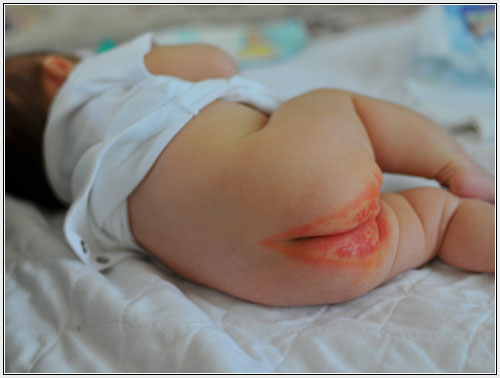
Diaper rash In Baby

3 comments

Diaper rash is a skin condition that develops in the area under a baby's diaper.

Causes

Diaper rash is common in infants between 4 and 15 months old and may be noticed more when babies start eating solid foods.
Diaper rash caused by infection with a yeast or fungus called Candida is very common in children. Candida is found everywhere in the environment and grows best in hot and humid, like under a diaper. A diaper rash is more related to fungi likely to occur in babies:
  • Not kept clean and dry
  • Are taking antibiotics, or whose mothers are taking antibiotics while breastfeeding
  • Have more frequent stools
Other causes of diaper rash include:
  • Acids in the stool (seen more often when the child has diarrhea)
  • Ammonia (produced when bacteria break down the urine)
  • Diapers that are too tight or rub the skin
  • Reactions to soaps and other products used to clean cloth diapers
  • Too much moisture

Symptoms

You may notice the following in the diaper area for your child:
  • Rash or outbreak of bright red becomes larger
  • Red scaly areas live in the scrotum and penis in boys
  • Or red scaly areas on the lips and vagina in girls
  • Pimples, blisters, ulcers, large bumps or pus-filled sores
  • Smaller red patches (called satellite lesions) that grow and are mixed with other patches
Older babies can scratch when they removed the diaper
Diaper rash usually does not spread beyond the edge of it.

Exams and Tests

Diaper rash or yeast related fungi often can be diagnosed only with its appearance. The examination of potassium hydroxide (KOH) can confirm a diagnosis of Candida

Treatment

The best treatment for diaper rash is to keep the diaper area clean and dry. This will also help prevent new dermatitis.
  • Always wash your hands after changing a diaper
  • Ask your doctor whether a cream for diaper rash would. Products based on zinc oxide or petrolatum help keep moisture away from the baby's skin when applied to the skin clean and dry
  • Avoid using wipes that contain alcohol or perfume as they can dry or irritate the skin
  • Do not use corn starch in your baby's bottom as it can worsen a diaper rash yeast
  • Do not use talc (talcum powder), since it can penetrate into the baby's lungs
  • Frequently change your baby's diaper, and as soon as possible after it urinates or defecates
  • Put your baby in a towel without a diaper when possible. The longer you can keep the diaper off, the better.
  • Pat the area dry or let air dry
  • Place loose diapers. Diapers that are too tight do not allow enough air and can rub and irritate the waist or thighs of the baby.
  • Use water and a soft cloth or cotton ball to gently clean the diaper area with each change it. Avoid rubbing or scrubbing the area. You can use a squirt bottle of water for sensitive areas
  • The use of highly absorbent diapers helps to keep skin dry and reduces the likelihood of infection
If you use cloth diapers:
  • Avoid plastic or rubber pants over the diaper. They do not allow enough air to pass
  • DO NOT use fabric softeners or dryer sheets as they can worsen the rash
  • When washing cloth diapers, rinse 2 or 3 times to remove all soap if your child has a rash or has had prior
MEDICATIONS:
Antifungal creams and ointments for topical skin clear up infections caused by yeast. Nystatin, miconazole, clotrimazole and ketoconazole are common.
Sometimes you can use a mild topical corticosteroid cream. Talk to your doctor before trying this with your baby.

Forecast

The rash usually responds well to treatment.

Complications

The complications associated diaper rash Candida may include:
  • Secondary infection

When to Contact a Medical Professional

Call your doctor if:
  • The rash gets worse or does not go away in 2 to 3 days.
  • The rash spreads to the abdomen, back, arms or face.
  • You notice pimples, blisters, ulcers, large bumps or pus-filled sores.
  • Your baby has a fever.
  • Your baby is taking an antibiotic and develops a bright red rash with spots on their edges. This could be a yeast infection.
  • Your baby develops a rash during the first 6 weeks of life.

Alternative Names

Diaper rash associated with Candida, Candida diaper rash, Diaper Rash

Friday, April 20, 2012

The best tips for your baby to sleep

0 comments
Do you remember when you slept eight hours a night without waking for nothing? If you have small children, probably will seem a distant memory. According to a survey by the American National Sleep Foundation in 2004 to 69 percent of children under age 10 have trouble falling asleep and staying asleep. What about the other 31 percent? What is your secret? To know we consulted with leading sleep experts. This enabled us to discover some of the surprising strategies that really work:


Babies do not sleep: basic course

Although infants tend to sleep 18 hours a day, are in short periods of time throughout the day. Here are some ideas for your little one gather such "sleep raticos" especially at night.

Put him in his crib when drowsy, not fully asleep
This is not easy, especially for moms who are breastfeeding, but if you can figure out how much you'll get the rest you need. Babies who sleep alone are more likely to fall asleep faster and learn how to soothe themselves to sleep, he claims Kim West, author of Good night, sleep tight (Good Night, Sleep Tight.) West is a social worker in Annapolis, Maryland, and a professional sleep consultant who has helped over 2,000 families across the country to sleep in their little ones.

This is his advice: When your baby is 6 to 8 weeks of sleep creates a scale of 1 to 10. 1 is fully awake and 10 is fast asleep. Wait until your baby is at number 7 and put it to sleep. Move arms and legs less vigorously and not suck so hard (moving from feeding, sucking to calm down) are clear signs that it is entering the world of dreams.

Try not to look at your baby's eyes
Many babies are stimulated very easily. A loving your look can make them happen to be tired to be in good shape faster than it takes to say, "Oh no". See how your baby reacts to your look is great and disheartening at noon to midnight.

Parents who maintain eye contact with the sleepy babies are inadvertently encouraging them to come out of the area of ​​sleep, says Claire Lerner, director of a nonprofit organization called Zero to Three that promotes the health of babies and young children. "The more interaction there is between you and your baby at night, have more motivation to wake up."

What can you do? Lerner suggests lower the level of everything. If you have to enter the area where your baby is sleeping at night, do not hold your gaze, you talk or sing your favorite song of Juanes. Keep your eye on her stomach and caress your back gently and sweet and calm voice.

Take him to the dark side
"The lights activate the button biological implementation of your child," says Elizabeth Pantley, author of The baby sleep without tears (No-cry sleep solution.) Conversely, the dark causes the brain to release melatonin, a hormone key to sleep.

If your baby sleeps during the day than at night, help to recognize the difference. During the day, let in plenty of sunshine in the house. Put your baby to nap during the day in well-lit rooms (unless you have trouble sleeping naps). To induce sleep at night installing dimmers on the lights, not only in the room of your baby but in other rooms where the two spend much time. Reduces light intensity one or two hours before the time of going to sleep at night, to set the mood. Night lights are fine, but choose ones that are small, bluish-off (the yellow and bright white are more stimulating).

If your child wakes during the night does not turn on the lights or take him to a room that is well lit. The transition from darkness to light tells your brain it's time to take action. Instead, reassure to go to sleep in the room. If the morning sun makes your child get up too early or if you have problems with afternoon naps, install curtains that darken the room.

Cut your dependence on the baby monitor
According Pantley, a mom or dad to jump every time I hear a sigh passed through the baby monitor is teaching your child to wake up more often. Instead, sync your post to go to comfort your child between the time you know you're awake and when you will begin to mourn his lungs. Wait a few minutes to give him the chance to calm down and go back to sleep alone. On coming before they put you mourn a full stop before you're too angry to go back to sleep.

In any case, is either to reduce the sensitivity of recording the sounds of your baby monitor. Adjust the volume so you can go when agitated, but not to hear every breath. Eventually, you might want to turn it off completely.

Relax the rules for changing diapers
Resist the urge to change your baby every time you wake up, wake up because you'll make more. Instead, put a good Pantley advises absorbent diaper night when you go to sleep. When you wake up, smell it to see if it is dirty and change only if there is no choice. And if you have to change, there is nothing to wake a baby more than a cold wet washcloth. Try replacing it with a warm washcloth.

And you thought things could not get worse: not sleeping babies to toddlers who do not

Hard to believe, but by the time your baby is two years, has spent more time asleep than awake. On average, children need 12 to 14 hours of sleep a day, including naps (Older children, 11 to 13 hours). Do not be alarmed if your child ends up with the routine of two naps. Around 18 months is not uncommon for a child to spend two naps a day. But reducing their naps in the middle means that the dream of at night is a high priority.

Keep the routine short and simple
A variety show with various acts: a bathroom, three books, two songs and a massage can delay the time to go to sleep forever. "Before you know it, your well-intended routine for bedtime has become for your child at a time of transition for the time to play," says Mary Ann LoFrumento, pediatrician and author of Simple Parenting: Understanding Your Newborn and Infant (Parenting simple: how to understand your baby and your child.) If your child resists going to bed, stay focused on sleep and do not let your child direct the show.

LoFrumento suggests that parents of children who have difficulty maintaining sleep to maintain a routine of no more than 15 minutes (it's okay to be a little longer if your child does not have trouble falling asleep). Fifteen minutes is all you need to take to put on pajamas, read two short books and say goodnight.

Make the connection
"One of the biggest mistakes parents make is not to connect the dream of children and their behavior during the day," says Pantley, who attributes many of the behaviors that are considered part of the "terrible twos" a lack of sleep . "Irritability, complaints, fights with his brother ... all are rooted in the lack of a good night's sleep." Her advice? Make him go to bed earlier. (See our next tip, "Recall the night")

Retrieves the night
Exercises control and provides an early hour of bedtime, preferably between 7 and 8 pm, says Pantley. "Children are not watching the clock to see what time it is. Just waiting to be told they have to go to bed." So pick one and keep it.

Controls the temperature
Certainly, the 72 degrees Fahrenheit (22 Celsius), seem very comfortable for a room, and that is fine when you're awake. But the ideal sleeping temperature is between 60 and 70 degrees Fahrenheit (16 and 21 degrees Celsius). This is because sleep comes with a drop in body temperature, and this is the reason that a bath before bedtime helps your child to sleep before. The bathroom leaves you warm and comfortable, and then the cooler temperature makes your body temperature drops, which causes him to sleep.

Lower the thermostat a bit at least one hour before bedtime. If you forget, install an automatic thermostat. Set it to lower the temperature in the afternoon and the rise in the morning, and your child can fit the rhythm.

Awaken your child at the same time each day
A consistent routine is important to wake up as a regular bedtime. Children must be raised at about the same time every day (with a difference of 30 minutes). Avoid letting them sleep late during the weekends, says Pantley. "What we do with this is to ask the children living in two different time zones, time zone during the week and one on the weekend," he says. "As a result, have jetlag permanent. "

The fact that your children do not benefit from a little extra sleep on the weekends does not mean that you do not go well. If the weekend morning is the only time to recover your sleep, Take turns with your partner for your child to continue waking up at the same time.

Children going to school and age to reason

As children do not sleep and do not need naps cots or nursery rhymes, develop a great skill: the ability to reason. "Parents have less direct control to make an older child goes to sleep, so the solution is to make your child a companion and show the importance of having a good night's rest."

Children 5 to 12 need 10 to 11 hours of sleep at night. Pantley suggests appeal to your logical side. At this age, children are old enough to understand that hormones that help them grow are released during the night, and they need sleep to reach its maximum height, he says. Use the same logic you use for good grades or sports: sleep well if their brains are in a better way to remember what they learned in school that day, and their bodies perform better at football matches.

End the night owl
Staying up late is one of the most common problems of children already attending school. Parents often contribute to the problem because they want to spend more time with their children at the end of the day. But let the countdown: "If your child needs 11 hours of sleep at night and tends to rise at 7 am, then you have to be asleep at 8 pm," says West.

Merienditas for Better Sleep
Make your child more prone to sleep giving something healthy to eat to help you sleep, an hour before you go to bed. There are some foods that naturally induce a release of serotonin, a sleep of our body. Try a glass of milk, whole wheat toast with a slice of cheese, half peanut butter sandwich or oatmeal with bananas.

During the day, reducing or eliminating foods or beverages containing caffeine six hours before bedtime. According to the National Sleep Foundation, 75 percent of school-age children have drinks with caffeine such as colas. Because most of these drinks are empty calories, consider eliminating them entirely from the diet of your child.

Avoid homework before bedtime
Children who do their homework before going to bed usually stay up late and are sleepy the next day. There are scientific studies that link the irregular patterns of sleep behavior and academic problems. The school children are desperate for more sleep, says LoFrumento. "Many parents have told me that their children have improved a lot in school after improving their sleep habits."

Instead of leaving your child's homework until the last minute, plan a regular time to work before or just after dinner, suggests LoFrumento. "Let your child has enough time to play sports, jog or just relax after a long day at school, but make sure you finish your work at 7:30 or 8 pm" If your child usually has problems because it has lot of homework, talk to your teacher or teacher. "

Choose well your child's mattress
Most adults spend hours choosing the perfect mattress for your own bed, but accept any mattress for the bed of his son, says Pantley. Pantley suggests that you lie in bed 30 minutes of your son. Analyze if it's comfortable, what the pillow and blanket if it is warm and comfortable. Make it a place you wanted to sleep.

Rule out medical problems
Like adults, children can have diseases or medical problems that interfere with your sleep. Up to 12 percent of children snore and up to 10 percent have sleep apnea, a disorder in which the airways become partially blocked and reduce air intake, which makes the child wakes from a deep sleep . Although the problem goes away for many children as they grow, help ask your pediatrician if your child snores too and if you are excessively sleepy during the day.

Monday, April 9, 2012

Choosing the best formula milk for your baby

1 comments


Nothing can replace everything seamlessly delivering breast milk, however, not all children have it for various reasons, the most common: the absence of milk in the mother, decreased mobility and consequently insufficient quantity and quality for the baby, the need for nutritional supplements when the child suffers from deficiencies in this area, the importance of some nutrients and immediate support of the formulas when premature babies, and the treatment of severe reflux in the child. In all these cases, the supply circuit first priority is the formula, so the choice of the best and most suitable for the child is essential.
Types of formulas
Depending on the age of baby milk formulas that are designed to meet specific needs. Thus, Home, cover the nutritional requirements of healthy infants up to 6 months and can then be used to supplement other food until old.
Then there are the Continuation Milk Formulas, which are recommended after six months of age as a complementary part of a mixed supply.
In addition to the above, there are those formulas on the market created for special dietary use in specific alterations, such as premature babies, those who were intolerant to lactose (maternal formulas) in those with atopic diseases and inborn errors of metabolism, among others. In the above cases, the ideal is to be sold by prescription because it is therapeutic formulas.
Standards for components
While these vary slightly from country to country, we will build on this opportunity in what he says the American Academy of Pediatrics (AAP) and the European Society of Pediatric Gastroenterology and Nutrition (SEGNP) about what the minimum and maximum levels for much of the necessary components to meet the nutritional requirements of infants.
In their publications, both companies would think it desirable to use liquid whole milk, evaporated or powdered infant feeding in less than six months old, due to its high concentration of protein, saturated fat and low in carbohydrates, specifically lactose.
However, if used in infants under six months of age requires the addition of 5 to 10 percent sucrose or dextrinomaltose.
As for proteins, Home Formulas (FLI) should provide a contribution of protein to ensure proper weight gain and linear growth similar to that of a breast fed baby. It is estimated that the protein requirement is not greater than 1.6 g/100 kcal.
Carbohydrates are another important point and are represented by lactose. Digestion and absorption of this takes place in the small intestine where it is hydrolyzed by enzyme lactase to the monosaccharides glucose and galactose. It is important, therefore, that less than six months, the lactose is the sole carbohydrate and did not include sucrose ideally beyond the year.
Fat is another important element, because they provide nearly 50 percent of calories and is a nutrient essential for proper development of the central nervous system and vehicle for the absorption of fat soluble.
Therefore, in Formulae Milk Start should not be absent and ideally its source must be of vegetable oil. To this, Milk Formulas generally add a vitamin supplement, inorganic nutrients, iron, zinc and nucleotides, among others.

Sunday, April 8, 2012

Discovered high levels of arsenic in baby formula

0 comments
The researchers highlighted the situation as "particularly worrying for babies" because of their vulnerability to the toxic effects of arsenic.
  • High contents of arsenic, carcinogenic chemical commonly found in rice, were found in several types of cereals and infant formula milk. Special Photo

Atlanta, United States. - High contents of arsenic, carcinogenic chemical commonly found in rice, were found in several types of cereals and formula milk for babies who use organic brown rice syrup as a sweetener, according to a Dartmouth College study released today.
The report, Published in Journal Environmental Health Perspectives, found that two of the 17 baby formulas which were tested had organic rice syrup as main ingredient and in one case the arsenic concentration level exceeding six times the limit federal.
The government sets a limit 10 parts per billion (ppb) and total arsenic in bottled water or consumption.
The researchers highlighted the situation as "particularly worrying for babies" because of their vulnerability to the toxic effects of arsenic on the relationship between their size and weight and the amount of arsenic consumed.
Also, the study found that 22 of 29 cereal bars or energy bars tested had organic brown rice syrup as a sweetener, rice flour, rice grains or rice flakes among its top five ingredients.
The researchers also analyzed the level of arsenic in energy drinks (in English, "energy shots") and found that one of the three varieties had a total of 84 ppb of arsenic, while the other 2 reached 171 ppb.
The study highlights the need for greater regulation as to the limits of this chemical in food due to the increasing prevalence of hidden arsenic in food.
A recent Consumer Reports study also found elevated levels of arsenic in apple and grape juices.
New legislation introduced in the House of Representatives of the United States last week, seeks to establish limits on levels of arsenic and lead in fruit juices.

Saturday, April 7, 2012

Choose the formula for your baby

0 comments
Since the baby is born, the best food you can receive is the breast milk , here we explain the basics of breastfeeding . Mother's milk in addition to having all the nutrients a baby needs to grow healthy and strong, also has elements immunizing passes through it. In addition, breastfeeding is more convenient for the mother, do not prepare the formula and sterilize bottles, feeding the baby at night is much more practical, not get up to prepare it. And it's certainly a lot cheaper. Not spent at all. It also helps the mother regain her figure and trim the kilos that have been gained during pregnancy, and assistance in the future health of women.

However, not always possible to breastfeed for various reasons. Some women have some difficulty breastfeeding for certain health conditions or other personal reasons. If this is your case, you should not feel bad or guilty, the formulas are also very good, and are made ​​to meet the nutritional needs of babies. Although they can not duplicate the exact chemical composition of breast milk, especially for its cells, hormones and antibodies to fight disease, contain carbohydrates, proteins, fats, vitamins and minerals in a manner similar to breast milk. There are mothers who breastfeed but at some point have to resort to formula. Give the bottle also allows you to convey love and affection to your baby. The formula should be used during the first year of baby's life, since children are not ready for cow's milk in the first 12 months of life. Next year you can give your baby whole milk, but not to use skim milk or reduced fat, they do not have enough calories and fat that the baby needs. Cow's milk alone is not an appropriate diet for infants because of the small kidney is not yet able to tolerate it, so it can eventually cause the non-tolerance to milk proteins. You will have a number of precautions when giving formula. Choose the formula for your baby First you should consult your pediatrician for advice choosing what type of formula for your baby. There are two basic types of formula: which is made ​​based on cow's milk, and made ​​based on soybean. It may be that babies are intolerant and have an allergic reaction to the one made ​​based on cow's milk, so they advise you to turn your made ​​based on soy. Some formulas are fortified with iron, others have very low doses of iron and other directly contain nothing of this mineral. There are several ways in which this product is presented:
  • Ready to use: This milk is more expensive but requires no prior preparation
  • Concentrated liquid is a bit cheaper than the previous one. Mixing the formula with water in equal parts.
  • Powder: It is the cheapest. Mixing the powder with water
Use only the formulas approved by health authorities, do not use homemade formulas as it may not contain all the nutrients your baby needs for healthy and normal development. formulas available
  • Home: For babies from 0 to 6 months.
  • Continuation: Between 6 and 12 months.
  • Formula for premature babies.
  • Lactose-free formula: For children between 0 and 24 months.
  • Formula based on soy protein: For infants allergic to milk protein.
  • Hydrolysed formula: For babies with allergies.
How to know whether to change the formula if the baby becomes fussy, if you have some allergic reactions, or if you notice any change in color or consistency of the stool of the baby, or frequency of the same, you may need to change the formula . If you notice any unusual symptoms you should consult your pediatrician, who will recommend to do. Hygiene and sterilization Hygiene is very important when preparing food for your baby. Note that the defense system of young babies is underdeveloped. You are advised to have a bottle for each shot, with a corresponding nipple. Sometimes the nipples bring a very small hole, making it difficult to suction the baby gets tired and swallow air, which can cause gas. If this happens enlarge the nipple hole with a hot needle. You must sterilize the bottles, caps and nipples themselves before first use. You can boil them in water for 5 minutes. Each time you finish using them should be washed with soap and water, and rinse them in abundance. Use a long brush to get to the bottom of the bottle and remove all traces of milk. You are advised to esterilices bottles and nipples once a day. Store in the refrigerator to keep them sterile. Do not store the remains of milk the baby stopped, they often become contaminated easily, if you throw them remained in the bottle for more than an hour. Preparation of the formula must wash your hands thoroughly before preparing. You must follow the instructions that came in each formula, carefully measuring the elements of the mix. If you put too little water can upset the stomach or kidneys of the baby, and if you add a lot, diminishes the quality of the food. Improper mixing of the ingredients can cause abdominal pain. It is recommended that if you use water, boil for 1 or 2 first minutes and then let it cool, or use bottled water. It is very safe to use unboiled tap water because it can be contaminated. For formula must use cold water. To warm formula, place the bottle in a pan with hot water and wait a few minutes to lukewarm. To see if you throw yourself at the correct temperature a few drops on the wrist. Just be warm, not hot. Do not use the microwave to heat the bottle, it may happen that the pacifier from getting too hot, or that the formula has been hot in some parts more than others, and the baby will burn. You should keep prepared formula in the refrigerator, well covered, but not freeze. You cover the open can of formula or liquid concentrate well in the refrigerator, and you use it within 48 hours after opening. Do not leave prepared formula out of the fridge for more than two hours. How much to take the baby? Usually you have to give the formula on demand. He will make you understand when you're hungry, and leave the bottle when full. Usually the formula has more calories than breast milk, so the baby will need fewer daily doses. Monthly monitoring is very important to the baby's weight, that will indicate if you are fed in appropriate amounts. To give you an idea, babies need approximately:
  • 6 to 8 shots of formula per day during the first month
  • 5 to 6 shots a day of formula 1 to 3 months
  • 4 to 5 shots per day of formula 3 to 7 months
  • 3 to 4 shots of formula per day for 7 to 9 months
The proper amount you should give at each feeding depends on the weight and age of the baby. It also depends on if these feeding in combination with breast milk or solid foods. So you should consult with your doctor to know about the baby milliliters need to consume per day.
 

Baby Smile Tips & Ariticle Copyright 2008 All Rights Reserved Baby Blog Designed by Ipiet | All Image Presented by Tadpole's Notez